
If my generation has a musical, and (I'm afraid to say) it probably doesn't, it's RENT. So though it's had a remarkable long run at the Nederlander Theatre on Broadway I couldn't help but be saddened by the news that it's time has finally come. My favorite memory of the show: Algebra class Freshman year of high school. Sitting in front of me was BJ, a large somewhat effeminate black boy. Day after day instead of paying attention to mathematrical proofs and the quadratic equation BJ would teach me the lyrics to Rent's showstopping Act-One closer: La Vie Boheme. It would be two years before I saw the show on Broadway but, by the time I did, I already knew the whole thing by heart. Goodbye Rent, we'll miss you!
Tuesday, January 15, 2008


Tuesday, January 8, 2008
Go Hillary!

Now that Edwards is all but dead in the water, Bobofag has become a full-on Clintonhead! I don't know what it is about Obama: His "above the fray" attitude? His bad health care plan? His habit of style over substance (what does all his talk of "change" even mean?) Whatever it is...I'll take Hillary's tough talk and specific policy initiatives any day. Plus, it's about time we get some estrogen power into the White House. Congrats Hill on New Hampshire...no one thought you could do it and you proved them wrong!
Wednesday, December 26, 2007
Tim Burton: Batman Returns (1992)
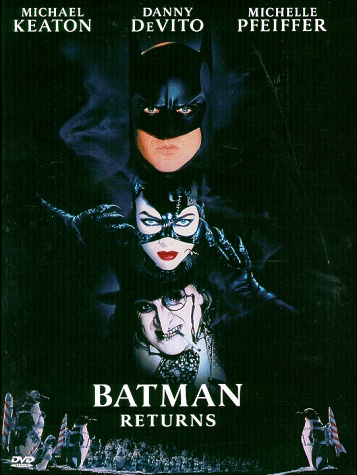
Batman was indisputably one of the biggest box office smashes of the 1980's and director Tim Burton was given the lion's share of the credit (and rightly so.) When the inevitable sequel was produced the director was awarded a level of control and trust that is rare within the mainstream studio system. Burton could pretty much do whatever he wanted. The result: a truly bizarre and unique Burton blockbuster (emphasis on the Burton) that pushed the boundaries of the genre even as it failed within them. Batman Returns was a box office hit to be sure, but on a much smaller scale than the original. Perhaps audiences were turned off by the films glum tone or it's overly fussy and complicated plot. Unrelentingly psychological, Batman Returns is totally flaccid as an action movie; the director seemingly having little patience for the elaborate and repetitive choreography that such sequences require. Instead the film functions as a study in the mental instability of it's main character; a better title would have been Batman: Deconstructed.
Dualities are everywhere. Metaphors of masks abound. Gotham city itself is turned into a theater of Freudian psychodrama. When I first saw the movie I was put-off by the abundance of villains in the piece- there are no less than three. I felt my focus being pulled in too many directions. What I now realize is that these three figures represent different aspects of Batman's psyche; his fight with them is actually his internal struggle with his own demons. Indeed we can see these characters as the classic Freudian modalities of Id, Ego and Superego.

For the Id we have the Penguin, Oswald Cobblepot (played by a snarling, barking Danny DeVito, channeling Burgess Meredith by way of Cujo). A brutal monster, lacking impulse control as much as he does dental hygiene, the Penguin is Batman's primary foe in Batman Returns, but even more importantly he is Wayne's inner darkness distilled and given a fetid, abhorrent form. The importance of animal imagery is pronounced: the Penguin is not human-he knows he is a monster..."I am an animal. Cold-Blooded!" As the penguin says to Batman "You're just jealous because I'm a real freak and you have to wear a mask." Biographically however, the Penguin is Bruce Wayne's dark doppelganger. Born into privileged homes, both were "abandoned" by their parents at a young age-an event that defines each mans identity. At a press conference where he visits the grave of his parents, the villain declares them forgiven as Bruce Wayne looks on. But, their absolution is a publicity stunt. Bruce Wayne too has not forgiven his parents for leaving him; he represses his anger toward them by punishing the criminals who took them from him allowing his parents to stay innocent (which of course they were, but this about irrational emotion here), a fetish of their memory is what remains. But Wayne's Id, it's desire to confront the feelings of resentment, get an outlet with the Penguin. There is a caveat. Cobblepot can only exist fully as a vile, uncontrollable monster, literally dwelling beneath Gotham, just as Wayne's monstrous animal id hides in the recesses of his mind, or least in his Batcave. When the feelings rise up to the surface and show themselves, pandemonium ensues.
Wayne's Ego is the corrupt billionaire industrialist Max Shreck, played to smarmy perfection by Christopher Walken in a fright wig. This is the public face of Wayne: rich, charming and successful. The interesting thing about the addition of this character is that, along with completing the Freudian trifecta, for the only time in the Batman movies is Wayne's guilt regarding his wealth even alluded to, however elliptically. Though he wears no mask, Shreck is as duplicitous a character as Wayne-legitimate business man by day and corrupt robber baron by night. Though with Shreck the duality is almost totally submerged- his villainy a natural extension of his profession. As Michael Atkinson points out in his Village Voice review of "Batman Begins," the Batman movies have always ignored any possible connection between the squalor and crime in Gotham city and Wayne's profession as a ludicrously wealthy business man. Though this level of social commentary is not realized in Batman Returns (or any Tim Burton movie), it is at least alluded to with Shreck. (Also alluded to is the cinema of German expressionism where the lead in Nosferatu was played by none other than one Max Shreck. And the Penguin is pure Caligari. But this is all neither here nor there.)

Finally we have a truly fascinating character played by Michelle Pfeiffer (in her best screen performance): Catwoman. Burton's only true successful female character (until Mrs. Lovett in Sweeney Todd) and his only foray into matters sexual, Catwoman is pure Super-ego. As Lacanian film theorist and philosopher Slovaj Zizek has often noted, the super-ego is not a moral agency. It is consuming voice that constantly and relentlessly bellows irrational demands on it's agent. Perhaps most interesting is Zizek's assertion that the Super-ego is connected deeply with the Id, the two aspects of the psyche being delicately reflective of each other. Norman Bates taking the corpse of his mother from the Super-ego attic to the Id basment is Zizek's example of a potent cinematic representation of this connection. In Batman Returns we can find another. Like the Penguin, but unlike Shreck, the Catwoman, like the Penguin (and like Batman for that matter) is an animal image.
Extremely articulate, undeniably witty and unabashedly sexual, the Catwoman is the Super-ego run amok, having totally discarded all pretense of social normality. Her first big battle with Batman occurs, appropriately, on a rooftop, just as the Super-ego sits at the highest level of subjectivity. Catwoman is also the nexus of Wayne's central neurotic predicament for she, unlike the Penguin or Shreck, is constantly fighting with her dual nature, the madness of her psychology displayed in the films most memorable scene where Selina destroys her pink-hued apartment and transforms into Catwoman. When she kills Shreck in the films dark final scene she finalizes the death of her and Wayne's Ego, preferring instead to remain the animal that she has become. And though the Penguin dies in this same moment, he is thematically returned to the subconscious, hidden in the sewers of Wayne's mind. Batman's attempts at reconciling his psychic traumas have been unsuccessful and even destructive. There seems little hope that Wayne will ever move beyond his schizophrenic predicament. Though he has once again saved Gotham, this, the real central conflict of the film, is not a setup for, as the Catwoman says, "A Happy Ending."
With Catwoman Burton also dabbles in sexual politics. Selina Kyle is a highly gendered character when we first meet her. Passive, pathetic, soft-spoken and sexually inert. "Hi Honey I'm home..oh that's right I'm not married" is her lament upon every return to her feminine apartment. Her lack of a "man" troubles her and at the same time defines her. Catwoman is a Betty Friedan nightmare, a dangerous castrating creature of menace powered by rocket fuel estrogen. With her S&M get-up of shiny pleather and her sybaritic line deliveries that practically echo Mae West-this Catwoman is more vagina than pussy.

As one can imagine, Bruce Wayne gets lost in the shuffle. The whole movie being a
representation of his psyche, Wayne is even more of a cipher here than he was in the first film. The few moments of character development allowed the talented Mr. Keaton are in relation to his budding romance with Selina Kyle, a duality again mirrored by Batman's more overtly sexual and violent meetings with Catwoman. The slight humor Wayne displayed in the first Batman is blunted even as the movies tone verges farther toward the whimsical.
Though Batman Returns is a far less comic film than it's often witty predecessor, it's mise en scene has a far more macabre frivolity. Returns is, in every way, more Burton's films than Batman was and his signature touches threaten to overtake the whole movie, for better or for worse. After Anton Furst committed suicide during pre-production Burton turned to his Scissorhands collaborator Bo Welch for production design. If Furst made Gotham into a mysterious expressionistic cesspool, Welch turns the city into a Transylvanian carnival. Color is everywhere, pronounced all the more by the surrounding darkness. Equally abundant is white snow. Setting the story at Christmastime has to be a sick joke of some sort; it adds nothing to the plot.
Burton's always been more Gorey than gory and in Returns his penchant for curlicue trimmings kills the sense of dark menace and urban blight that epitomized Furst's Gotham. It's no wonder that Batman battles a gang of demented circus clowns; who else to populate Burton's circus of Hell? With all the clowns running around in the white blankets of snow the mood can get deciedly Cirque Du Soleil. Also ratcheting up the sideshow aura is Danny Elfman's score which, although featuring some of his best work (Selina's transformation again is a highlight), is nevertheless oppressively heavy on the creepy-yet-innocent choir of "ooh's and laah's" that Elfman finds so fetching. In almost...every...movie. Burton, always afraid to have a moment on screen without oppressive musical accompaniment does nothing to reign him in. The original Batman hinted that Elfman could become the new John Williams, with Returns he negates any such ambition; he is simply so wrapped up in his own sound that that is all he, and the audience of a Tim Burton movie, can hear.
Obviously, Batman Returns is an interesting movie--much more so than almost anyone gives it credit for, including myself until I started thinking about it. Playing as it does on complicated psychological and sexual issues, a box office fallout was inevitable. It's important to remeber that though that, out of the shoadow of the previous iteration, Batman Returns was still amazingly successful. Perhaps the name brand recognition was still hot enough to secure an impressive release, or perhaps the films themes were subtextual enough to not sink the whole thing under the weight of it's own metaphoric import (see: The Hulk, dir. Ang Lee). Whatever the reason, the movie made a lot of money but it's comparative failure to the earlier Batman I can't help but to believe came about by it's somewhat serious engagement with the issues that I have noted in this review. The result was one of the more disappointing entries in the now tirelessly burgeoning genre of Superhero film, but one of the greatest (though flawed) entries in Burton's oeuvre. It's without question a film worth watching again.
Monday, December 17, 2007
Sondheim: Follies (1971)
It could never happen again. It should have never happened at the time. The unbelievably extravagant, exceedingly expensive and ridiculously ambitious 1971 musical Follies was a musical perhaps doomed to failure. Shockingly downbeat, Follies marked the end of a Broadway that sparkled with glamour and fantasy, ushering in a new area of cynicism and modernity. It was another experiement in creating a whole new kind of musical. Follies began in the mind of Stephen Sondheim as a murder mystery called "The Girls Upstairs." After much reworking, and with Hal Prince's guiding hand, the show transformed into a massive eulogy for youth, hope and old "42nd Street" showbiz. Inspired by a startling photograph of Gloria Swanson amid the wreckage of an abandoned, dilapidated theatre, Follies is set at the first, and last, reunion party for Weissman's Follies (a transparent Ziegfield stand-in) before the old theatre gets torn down. As one character barbs, "Just what this city needs, another parking lot." Specifically focusing on two middle-aged former Follies girls and their stage-door Johnny husbands, (Sally and Buddy, Phyllis and Ben, respectively) we are invited to luxuriate in the destructive dynamics and long stewing resentments of two collapsing marriages. Old romances are rekindled (and discarded); hopes for the future are shown futile. Through the metaphors of show-biz, these domestic dramas are elevated into the more universal crisis of age and loss. A true concept musical, the action plays on a dream stage where the ghosts of the past literally share space with the harsh realities of the present.
There are two kinds of music in Follies. Most transparent are the pastiche; songs written deliberately in the manner of the tin pan alley tunesmiths of the 20's and 30's. The other songs are uniquely Sondheim-esque and contemporary. All are brilliant. In Follies Sondheim was able to display his complete mastery of theatre music, tossing off Irving Berlin and George Gershwin homages that often outdid their real inspirations. Better yet, Sondheim's lyrics in these pastiche numbers worked on two levels: they are fully believable as period pieces and they also subtly comment on the action, providing discomfiting irony to each musical moment. No where is this more obvious than in the Act-one showstopper "Who's that Woman." As the aging chorus girls sing a cheery bouncy dance number, the lyrics cut to the quick. "Who's that woman?/That cheery, weary woman/Who's dressing for yet one more spree?/Each day I see her pass/In my looking-glass--/Lord, Lord, Lord, that woman is me! " As they dance with their old selves, the ladies "mirror" image becomes all the more poignant-their feeble attempt at dancing more pathetic. Even the grand opening, a parody of Irving Berlin's Follies classic "A Pretty Girl" called "Beautiful Girls" has a more than subtle hint of the pathetic and grotesque to it,-as all the old, wrinkled, heavy and frail former Follies girls parade down the staircase one last time, nostalgia quickly transforms to sadness and disgust.
Eventually the regrets and recriminations of the the four main characters comes to a head, boiling over and transforming the stage into a new and one-of-a-kind show; a full-fledged Follies of psychological dysfunction and released repression. As each of the main characters has their moment in the spotlight the futility of the entire endeavor becomes more and more obvious. Eventually invoking a nervous collapse from Ben, the stage becomes awash in a cacophony of noise-all the characters bellowing while the orchestra thrashes in a nonsenical din. Leaving the party with the spouses they came with, the characters may leave wiser for the wear-but happiness remains nonetheless an elusive dream.
A massive cast, an incredible orchestra, costumes opulent beyond any seen since--Follies was one of the most expensive shows Broadway had ever seen. All this to service a show that, as described above, leaves it's audience less than joyful. The critics that disliked the show focused on Williams Goldman's book which they saw as petty. Why would anyone want to spend an evening with these four sad pathetic people who spend a whole show complaining and bitching with each other about events long since passed? The point is not without insight but what those critics missed is the more universal and powerful thematic ideas facilitated by this plot. No, the characters don't really change or grow, but that is, of course, the point. Sondheim and Price simply weren't interested in playing by the rules. The shows most insightful review was written by a Harvard student, a precocious young fellow named Frank Rich. He had already written his place in the history of criticism with a line that epitomized Follies raison d'etre: "There is no getting around the fact, that a large part of the chilling fascination of `Follies' is that its creators are in essence presenting their own funeral."
Follies did not recoup it's invest despite a run of 522 performances on Broadway. A National tour also fizzled early. Ever since, the show has achieved a legendary status, not only for the brilliance of it's score but for the perfection and unattainable opulence of the original production. Chronicled in the book "Everything Was Possible" by Ted Chapin, the history of Follies is mythic among theatre aficionados and for good reason. But this has not stopped people from attempting to remount the show and make it a viable entertainment once again. A star-studded 1985 concert with Mandy Patinkin, Barbara Cook, George Hearn and Lee Remick cemented Follies status as one of the most brilliant scores in Broadway history. The 1998 Paper Mill Playhouse Production dared to ask if a fully mounted revival could succeed. The answer seemed to be a resounding "yes!" Critic swooned. When an slimmed down revival appeared on Broadway in 2001, the results were underwhelming. Once again Follies proved a classic problem play, unrelentingly interesting but stubbornly unproducable. The recent critical and commercial success of another concert staging, this time at City Center Encores, stirred up discussions of yet another possible try for Broadway gold-but so far no official word has confirmed the chatter.
And probably for the best. Follies will never be a commercial success; it's subject matter too bleak, it's financial demands too great. In a concert staging, pressures are lessened and the imagination takes hold, closing the gaps that a real production would have to fill. For those who saw it, memories of the original persist. For those who didn't, like Bobofag, the idea of a fully realized Follies is probably better than the real thing. Follies remains a frustrating, sad, dark and numbingly brilliant musical, all the more enticing for it's many flaws. It's unrealistic demands of production and it's taxing emotional experience for the audience make Follies better imagined than real. Like a young child staring at his beautifully wrapped Christmas gift, the toy itself can never quite live up to the anticipation.
There are two kinds of music in Follies. Most transparent are the pastiche; songs written deliberately in the manner of the tin pan alley tunesmiths of the 20's and 30's. The other songs are uniquely Sondheim-esque and contemporary. All are brilliant. In Follies Sondheim was able to display his complete mastery of theatre music, tossing off Irving Berlin and George Gershwin homages that often outdid their real inspirations. Better yet, Sondheim's lyrics in these pastiche numbers worked on two levels: they are fully believable as period pieces and they also subtly comment on the action, providing discomfiting irony to each musical moment. No where is this more obvious than in the Act-one showstopper "Who's that Woman." As the aging chorus girls sing a cheery bouncy dance number, the lyrics cut to the quick. "Who's that woman?/That cheery, weary woman/Who's dressing for yet one more spree?/Each day I see her pass/In my looking-glass--/Lord, Lord, Lord, that woman is me! " As they dance with their old selves, the ladies "mirror" image becomes all the more poignant-their feeble attempt at dancing more pathetic. Even the grand opening, a parody of Irving Berlin's Follies classic "A Pretty Girl" called "Beautiful Girls" has a more than subtle hint of the pathetic and grotesque to it,-as all the old, wrinkled, heavy and frail former Follies girls parade down the staircase one last time, nostalgia quickly transforms to sadness and disgust.
Eventually the regrets and recriminations of the the four main characters comes to a head, boiling over and transforming the stage into a new and one-of-a-kind show; a full-fledged Follies of psychological dysfunction and released repression. As each of the main characters has their moment in the spotlight the futility of the entire endeavor becomes more and more obvious. Eventually invoking a nervous collapse from Ben, the stage becomes awash in a cacophony of noise-all the characters bellowing while the orchestra thrashes in a nonsenical din. Leaving the party with the spouses they came with, the characters may leave wiser for the wear-but happiness remains nonetheless an elusive dream.
A massive cast, an incredible orchestra, costumes opulent beyond any seen since--Follies was one of the most expensive shows Broadway had ever seen. All this to service a show that, as described above, leaves it's audience less than joyful. The critics that disliked the show focused on Williams Goldman's book which they saw as petty. Why would anyone want to spend an evening with these four sad pathetic people who spend a whole show complaining and bitching with each other about events long since passed? The point is not without insight but what those critics missed is the more universal and powerful thematic ideas facilitated by this plot. No, the characters don't really change or grow, but that is, of course, the point. Sondheim and Price simply weren't interested in playing by the rules. The shows most insightful review was written by a Harvard student, a precocious young fellow named Frank Rich. He had already written his place in the history of criticism with a line that epitomized Follies raison d'etre: "There is no getting around the fact, that a large part of the chilling fascination of `Follies' is that its creators are in essence presenting their own funeral."
Follies did not recoup it's invest despite a run of 522 performances on Broadway. A National tour also fizzled early. Ever since, the show has achieved a legendary status, not only for the brilliance of it's score but for the perfection and unattainable opulence of the original production. Chronicled in the book "Everything Was Possible" by Ted Chapin, the history of Follies is mythic among theatre aficionados and for good reason. But this has not stopped people from attempting to remount the show and make it a viable entertainment once again. A star-studded 1985 concert with Mandy Patinkin, Barbara Cook, George Hearn and Lee Remick cemented Follies status as one of the most brilliant scores in Broadway history. The 1998 Paper Mill Playhouse Production dared to ask if a fully mounted revival could succeed. The answer seemed to be a resounding "yes!" Critic swooned. When an slimmed down revival appeared on Broadway in 2001, the results were underwhelming. Once again Follies proved a classic problem play, unrelentingly interesting but stubbornly unproducable. The recent critical and commercial success of another concert staging, this time at City Center Encores, stirred up discussions of yet another possible try for Broadway gold-but so far no official word has confirmed the chatter.
And probably for the best. Follies will never be a commercial success; it's subject matter too bleak, it's financial demands too great. In a concert staging, pressures are lessened and the imagination takes hold, closing the gaps that a real production would have to fill. For those who saw it, memories of the original persist. For those who didn't, like Bobofag, the idea of a fully realized Follies is probably better than the real thing. Follies remains a frustrating, sad, dark and numbingly brilliant musical, all the more enticing for it's many flaws. It's unrealistic demands of production and it's taxing emotional experience for the audience make Follies better imagined than real. Like a young child staring at his beautifully wrapped Christmas gift, the toy itself can never quite live up to the anticipation.
Wednesday, December 12, 2007
Bad Marketing Ideas
Believe it or not, only one of these is a fake. Can you guess which? I'll give you a hint, it's not the one that bought advertising time during Project Runway (raise of eyebrow).
Monday, December 10, 2007
Kant '08
Bobofag proudly admits that he was once a nerdy philosophy minor in college. His thinking still occasionally drifts toward the metaphysic and epistemic. So he did laugh most heartily when he saw this attack ad on youtube. Good Kantian that he is, Bobfag does not endorse it's contents:
Subscribe to:
Posts (Atom)