Showing posts with label Tim Burton. Show all posts

Tuesday, July 22, 2008

Long Day's Journey into THE DARK KNIGHT. A Dissenting review.


When people ask me if the much lauded new Batman movie The Dark Knight is as good as the critics are saying I first ask if they liked Batman Begins. If they respond that they do, I assure them that they'll probably like the new Batman even more. If however they were, like me, disappointed in Christopher Nolan's first go-round with the caped crusader, then they will probably be equally unimpressed by the sequel which, in many ways, offers more of the same. While The Dark Knight is in most ways a more exciting, involving and thrilling film than it's predecessor, it also pissed me off more than Batman Begins and highlights the deficiencies in Nolan's interpretation of the character more acutely.

Memento was one of the greatest films of it's genre; more than a simple screenwriting stunt, Memento transcends it's M.C. Escher narrative gimmicks and uses it's plot to question deep and philosophical problems about human nature, epistemology, and the power of memory. Nolan's The Prestige, though less successful, was a film about illusions that itself was something of a mind-bending magic trick-though the thematic ideas raised never quite became actualized with the elegance that Nolan displayed in Memento. In any event he is certainly one of our most important and talented new filmmakers. But his take on Batman is all wrong.

Batman Begins was primarily a reaction to the so-campy-drag-queens-stayed-away aesthetic that Joel Schumacher employed in his two terrible Batman films, Batman And Robin being one of the worst big-budget movies ever made. Draining away all humor, color, and camp Christopher Nolan refastened Batman as an utterly realistic action film with "deep" Freudian overtones. Nolan was willing to "take Batman seriously" and fanboys swooned.

Bumping up the portentousness and length, The Dark Knight only furthers Nolan's tunnel-visioned agenda. If Batman Begins was a globe-trotting action movie with a kung-fu vibe, The Dark Knight is pure contemporary crime caper, more reminiscent of the Michael Mann oeuvre or Scorsese's The Departed than the other Batman films. And here is the problem: to play Batman with a totally straight face-to demand that the audience believe in the "realism" of the story is to siphon away all the mythic and larger than life undertones that sustain Batman in our collective imagination. Worse yet is that Nolan is not even playing by his own rules, fashioning a story that, upon even the barest scrutiny, is utterly ridiculous, confusing and plain unbelievable. Of course, stretching the credulity of an audience in a superhero movie is par for the course, what makes it a problem here is Nolan's bull-headed refusal to own up to this fact. Everything stylistically about the movie asks us to take what we see literally. But to do so is to believe in a confusing plot with gaping holes and all-too-convenient turns of events.

I guess I should be up front and say that I think the original Tim Burton Batman is the pinnacle of the genre: a stylish, funny, brilliantly-cast, popcorn picture that strikes a perfect balance between the silly and the serious. Burton's sequel pushes both those two categories even further making for a Batman movie that, while fascinating, was more about Burton than Bob Kane's creation. Burton, with Anton Furst and Bo Welch's invaluable assistance, created a whole world for Batman, one that was not exactly contemporary but not period either-it was as much set in '39 and '89. A dark, squalid Gotham City of Gothic Arches and expressionistic angles, it was a world where a Batman makes sense. Our hero was an extension of the unique urban mise en scene. Nolan's Gotham is a bland, non-descript realistic city (actually Chicago) where Batman looks like a non sequitur. In this environment it's hard not to feel that a man dressed as a bat is not just bizarre but downright stupid. As is a homicidal terrorist dressed as a clown.

Speaking of the clown, there is one bright spot in this movie and it's the one everyone is talking about- Heath Ledger's performance as The Joker. Relentlessly fascinating, Ledger dives headfirst into Nolan's rethinking of the character. No longer a demented comic prankster, The Joker has become a no-holds-barred terrorist with a nihilist streak. The screen comes alive whenever he is on. Stumbling out of a burning car licking his lips and grinding his yellow teeth, the image is hard to take your eyes away from. Ledger is a monster for the ages. Though his sense of humor is a only fit for an audience of one (he does have one sick and funny bit with a pencil) his lithe gait, and emotional unpredictability make him immensely watchable. Sadly, while Ledger performs admirably, Nolan's overall vision of the character suffers from the same problems that plague the whole movie. More a textual effect than a character, like Chiurgh in No Country For Old Men, The Joker is an idea actualized. Spouting lines that sound like fringe characters in Tom Stoppard's Coast of Utopia trilogy, this Joker informs us of his ideological perspective at every opportunity. He's sounds like Max Stirner on a mean bender. As he tells one character, "I am an agent of chaos." Yeah, no shit. What's ludicrous is that there is no point, as there arguably is in "No Country," where the filmmaker pushes the character into that ambiguous realm where the audience questions his very authenticity as a "real person." Yet, looked at objectively, Ledger's Joker does utterly impossible things: single handedly take over the crime syndicate of Gotham, avoid any and all detection by the police (even though he's hardly, shall we say, inconspicuous), lay trap within trap and plot within plot-a matryoshka doll of scheming impossible to actually execute, (Oh, I see he planned to get caught only to escape by detonating the bomb he planted in the other inmates stomach beforehand. How very, ahem, elaborate!) and most egregious of all, he plants massive, massive amounts of explosives at relatively protected buildings and boats and no one notices! Even his total absence of back story is a testimony to a conception of the role that is more than human. One can but wish Nolan had the guts to create a whole world where this sort of character made sense. Instead, the gaps in the plot look like just that: gaps.


The rest of the cast fares moderately with Bale having almost nothing to do as Batman but growl as ridiculously as he did in Batman Begins . He has even less to do as Bruce Wayne. Just as Tony Stark is more interesting than Iron Man and Clark Kent's the thing that makes Superman enjoyable, Bruce Wayne should have a character to play that actually holds our attention before he dons the batsuit! So far only Michael Keaton has played a Bruce Wayne who is anything but bland. Aaron Eckhart is fine as Harvey Dent/Two-Face though the maneuvers in the plot that turn him into the villain feel forced, as does the bizarre, over-determined canonization of Dent at the end of the film. Maggie Gyllenhaal is an improvement over Katie Holmes (as every single review is OVERJOYED to mention-is there some weird Schadenfreude going on here?) but the character is still a non-starter. Vicki Vale had more to do. Not to mention that the chemistry between her and Bale is utterly phlegmatic. Michael Caine and Morgan Freeman add some gravitas to the proceedings but their characters are still only plot placeholders and mouthpieces for Nolan's thematic occupations. Neither are granted a life outside the narrowly confined cog they serve in the plot. Perhaps the best supporting performance is by Gary Oldman (what role can't this man play?) who imbues Commissioner Gordon with real sensitivity and dignity. He is the real heart of Gotham. Nestor Carbonell makes for a Gavin Newsome-esque mayor and it's a delight to see the underemployed Eric Roberts as a big shot wise guy.

Ultimately, The Dark Knight collapses under the weight of its own ambition and self-importance. If the moment to moment excitement of the action was stupendous the lugubrious hand wringing would be more forgivable but Nolan, as in Batman Begins, has little clue how to film an action sequence. While there is one exciting car chase sequence in the films middle and the bank heist sequences that opens the movie has some style (though of a kind not a appropriate for a Batman flick) most of the action is an over edited, extreme close up-ed mess. While Burton was never a Spielberg or Cameron when it came to action sequences, he nonetheless was able to give them a narrative clarity and perspective that was both fun and lucid. The finale of The Dark Knight by contrast is an incomprehensible, darkly light, tortuously organized set piece that, using his new batty echolocation powers, Batman saves various hostages, fights the cops (though hurting none of them), disposes of some fake Batmen and finally has a showdown with the Joker who, wouldn’t ya know it, is protected by a hitherto unseen pack of hungry Rottweilers. Half the sequence is shot in sonar and the other have in near total darkness. Needless to say it's anticlimactic-especially true since we have a further climax and showdown with Two-Face yet to come.

Confusing humorlessness, literalness and solemnity with profundity and seriousness of purpose, Nolan can't make Batman soar. In the end, for all its talk about justice, chaos, social rules and vigilante violence, the films themes are extremely muddy. The finale even implies that a noble lie is better than hard-earned or tough-to-swallow truth (and it doesn't even illustrate convincingly THAT point of view). Is that what Batman has come too, a dirge? A sepulchral morality play that can't even muster up a coherent lesson to teach? Is having, you know, "fun" at a Batman forever off-limits. Though Ledger sometimes breaks through the barricades stacked against him, with Nolan at the helm, those days are over.

In a final note, I want to say something that the rabid fans are going to get their panties in a twist about. It's easy to wonder: Why all the love? Why the knee-jerk approval and devotion to Nolan's conception of Batman? I don't want to disparage any viewer’s enjoyment of the movie for its merits. I am sure many people like and even love the film for the qualities in it, even if my take on those very same things garners the opposite reaction. I venture to guess however that the critical hosannas showered upon Batman Begins and The Dark Knight is largely due to a deep desire in comic book fans (or at least comic book movie fans, which is to say a majority of the American population) to have their hobby taken seriously as art and a equally deep desire in critics to have summer blockbusters at least attempt somthing resembling thought and art. Though anyone who pre-judges any work of art based on the stereotypes of its genre is a douche bag, it is nonetheless true that superhero movies are usually considered adolescent larks, comic books themselves neither legitimate as art or literature. While this attitude is unfair, the prejudice is widespread and not without some justification. By making a realistic, humorless Batman series and weighing it down with heavy-handed talk about "fear" "justice" and "chaos" the fanboys feel legitimized and the critics are simply grateful for the gesture. "See, all this comic book stuff isn't just for kids! Look how MEANINGFUL and SERIOUS it all is!" If fanboys have too much fun at a Batman movie it only reinforces the idea that Batman is something fit for a Happy Meal and if critics have to much fun the assume it can't be a good film behind all the frivolity. Approval by the chattering classes and the mainstream is something important to people, even though many deny any such thing. A movie like The Dark Knight begs to be treated as a "serious" work of art. What's ironic is that this desire is the exact thing that makes it fail.

Wednesday, December 26, 2007

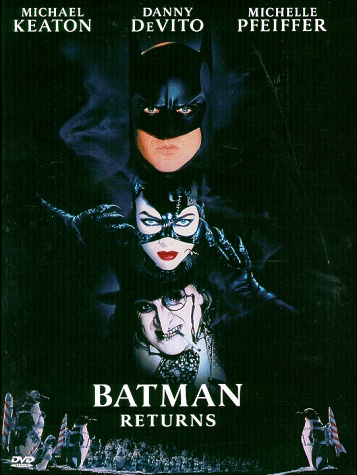
Tim Burton: Batman Returns (1992)


Batman was indisputably one of the biggest box office smashes of the 1980's and director Tim Burton was given the lion's share of the credit (and rightly so.) When the inevitable sequel was produced the director was awarded a level of control and trust that is rare within the mainstream studio system. Burton could pretty much do whatever he wanted. The result: a truly bizarre and unique Burton blockbuster (emphasis on the Burton) that pushed the boundaries of the genre even as it failed within them. Batman Returns was a box office hit to be sure, but on a much smaller scale than the original. Perhaps audiences were turned off by the films glum tone or it's overly fussy and complicated plot. Unrelentingly psychological, Batman Returns is totally flaccid as an action movie; the director seemingly having little patience for the elaborate and repetitive choreography that such sequences require. Instead the film functions as a study in the mental instability of it's main character; a better title would have been Batman: Deconstructed.

Dualities are everywhere. Metaphors of masks abound. Gotham city itself is turned into a theater of Freudian psychodrama. When I first saw the movie I was put-off by the abundance of villains in the piece- there are no less than three. I felt my focus being pulled in too many directions. What I now realize is that these three figures represent different aspects of Batman's psyche; his fight with them is actually his internal struggle with his own demons. Indeed we can see these characters as the classic Freudian modalities of Id, Ego and Superego.


For the Id we have the Penguin, Oswald Cobblepot (played by a snarling, barking Danny DeVito, channeling Burgess Meredith by way of Cujo). A brutal monster, lacking impulse control as much as he does dental hygiene, the Penguin is Batman's primary foe in Batman Returns, but even more importantly he is Wayne's inner darkness distilled and given a fetid, abhorrent form. The importance of animal imagery is pronounced: the Penguin is not human-he knows he is a monster..."I am an animal. Cold-Blooded!" As the penguin says to Batman "You're just jealous because I'm a real freak and you have to wear a mask." Biographically however, the Penguin is Bruce Wayne's dark doppelganger. Born into privileged homes, both were "abandoned" by their parents at a young age-an event that defines each mans identity. At a press conference where he visits the grave of his parents, the villain declares them forgiven as Bruce Wayne looks on. But, their absolution is a publicity stunt. Bruce Wayne too has not forgiven his parents for leaving him; he represses his anger toward them by punishing the criminals who took them from him allowing his parents to stay innocent (which of course they were, but this about irrational emotion here), a fetish of their memory is what remains. But Wayne's Id, it's desire to confront the feelings of resentment, get an outlet with the Penguin. There is a caveat. Cobblepot can only exist fully as a vile, uncontrollable monster, literally dwelling beneath Gotham, just as Wayne's monstrous animal id hides in the recesses of his mind, or least in his Batcave. When the feelings rise up to the surface and show themselves, pandemonium ensues.

Wayne's Ego is the corrupt billionaire industrialist Max Shreck, played to smarmy perfection by Christopher Walken in a fright wig. This is the public face of Wayne: rich, charming and successful. The interesting thing about the addition of this character is that, along with completing the Freudian trifecta, for the only time in the Batman movies is Wayne's guilt regarding his wealth even alluded to, however elliptically. Though he wears no mask, Shreck is as duplicitous a character as Wayne-legitimate business man by day and corrupt robber baron by night. Though with Shreck the duality is almost totally submerged- his villainy a natural extension of his profession. As Michael Atkinson points out in his Village Voice review of "Batman Begins," the Batman movies have always ignored any possible connection between the squalor and crime in Gotham city and Wayne's profession as a ludicrously wealthy business man. Though this level of social commentary is not realized in Batman Returns (or any Tim Burton movie), it is at least alluded to with Shreck. (Also alluded to is the cinema of German expressionism where the lead in Nosferatu was played by none other than one Max Shreck. And the Penguin is pure Caligari. But this is all neither here nor there.)


Finally we have a truly fascinating character played by Michelle Pfeiffer (in her best screen performance): Catwoman. Burton's only true successful female character (until Mrs. Lovett in Sweeney Todd) and his only foray into matters sexual, Catwoman is pure Super-ego. As Lacanian film theorist and philosopher Slovaj Zizek has often noted, the super-ego is not a moral agency. It is consuming voice that constantly and relentlessly bellows irrational demands on it's agent. Perhaps most interesting is Zizek's assertion that the Super-ego is connected deeply with the Id, the two aspects of the psyche being delicately reflective of each other. Norman Bates taking the corpse of his mother from the Super-ego attic to the Id basment is Zizek's example of a potent cinematic representation of this connection. In Batman Returns we can find another. Like the Penguin, but unlike Shreck, the Catwoman, like the Penguin (and like Batman for that matter) is an animal image.

Extremely articulate, undeniably witty and unabashedly sexual, the Catwoman is the Super-ego run amok, having totally discarded all pretense of social normality. Her first big battle with Batman occurs, appropriately, on a rooftop, just as the Super-ego sits at the highest level of subjectivity. Catwoman is also the nexus of Wayne's central neurotic predicament for she, unlike the Penguin or Shreck, is constantly fighting with her dual nature, the madness of her psychology displayed in the films most memorable scene where Selina destroys her pink-hued apartment and transforms into Catwoman. When she kills Shreck in the films dark final scene she finalizes the death of her and Wayne's Ego, preferring instead to remain the animal that she has become. And though the Penguin dies in this same moment, he is thematically returned to the subconscious, hidden in the sewers of Wayne's mind. Batman's attempts at reconciling his psychic traumas have been unsuccessful and even destructive. There seems little hope that Wayne will ever move beyond his schizophrenic predicament. Though he has once again saved Gotham, this, the real central conflict of the film, is not a setup for, as the Catwoman says, "A Happy Ending."

With Catwoman Burton also dabbles in sexual politics. Selina Kyle is a highly gendered character when we first meet her. Passive, pathetic, soft-spoken and sexually inert. "Hi Honey I'm home..oh that's right I'm not married" is her lament upon every return to her feminine apartment. Her lack of a "man" troubles her and at the same time defines her. Catwoman is a Betty Friedan nightmare, a dangerous castrating creature of menace powered by rocket fuel estrogen. With her S&M get-up of shiny pleather and her sybaritic line deliveries that practically echo Mae West-this Catwoman is more vagina than pussy.


As one can imagine, Bruce Wayne gets lost in the shuffle. The whole movie being a
representation of his psyche, Wayne is even more of a cipher here than he was in the first film. The few moments of character development allowed the talented Mr. Keaton are in relation to his budding romance with Selina Kyle, a duality again mirrored by Batman's more overtly sexual and violent meetings with Catwoman. The slight humor Wayne displayed in the first Batman is blunted even as the movies tone verges farther toward the whimsical.

Though Batman Returns is a far less comic film than it's often witty predecessor, it's mise en scene has a far more macabre frivolity. Returns is, in every way, more Burton's films than Batman was and his signature touches threaten to overtake the whole movie, for better or for worse. After Anton Furst committed suicide during pre-production Burton turned to his Scissorhands collaborator Bo Welch for production design. If Furst made Gotham into a mysterious expressionistic cesspool, Welch turns the city into a Transylvanian carnival. Color is everywhere, pronounced all the more by the surrounding darkness. Equally abundant is white snow. Setting the story at Christmastime has to be a sick joke of some sort; it adds nothing to the plot.
Burton's always been more Gorey than gory and in Returns his penchant for curlicue trimmings kills the sense of dark menace and urban blight that epitomized Furst's Gotham. It's no wonder that Batman battles a gang of demented circus clowns; who else to populate Burton's circus of Hell? With all the clowns running around in the white blankets of snow the mood can get deciedly Cirque Du Soleil. Also ratcheting up the sideshow aura is Danny Elfman's score which, although featuring some of his best work (Selina's transformation again is a highlight), is nevertheless oppressively heavy on the creepy-yet-innocent choir of "ooh's and laah's" that Elfman finds so fetching. In almost...every...movie. Burton, always afraid to have a moment on screen without oppressive musical accompaniment does nothing to reign him in. The original Batman hinted that Elfman could become the new John Williams, with Returns he negates any such ambition; he is simply so wrapped up in his own sound that that is all he, and the audience of a Tim Burton movie, can hear.

Obviously, Batman Returns is an interesting movie--much more so than almost anyone gives it credit for, including myself until I started thinking about it. Playing as it does on complicated psychological and sexual issues, a box office fallout was inevitable. It's important to remeber that though that, out of the shoadow of the previous iteration, Batman Returns was still amazingly successful. Perhaps the name brand recognition was still hot enough to secure an impressive release, or perhaps the films themes were subtextual enough to not sink the whole thing under the weight of it's own metaphoric import (see: The Hulk, dir. Ang Lee). Whatever the reason, the movie made a lot of money but it's comparative failure to the earlier Batman I can't help but to believe came about by it's somewhat serious engagement with the issues that I have noted in this review. The result was one of the more disappointing entries in the now tirelessly burgeoning genre of Superhero film, but one of the greatest (though flawed) entries in Burton's oeuvre. It's without question a film worth watching again.

Thursday, December 6, 2007

Tim Burton: Edward Scissorhands (1990)


Though Ed Wood and Sweeney Todd are probably better films, Edward Scissorhands is Tim Burton's defining masterpiece as cinema auteur. Crystallizing and distilling the directors thematic preoccupations, Scissorhands is a remarkable achievment of artistic purity and personal expression.

The persona of Edward himself is Burton's cinematic avatar par excellence. With his wily main of black hair, emotional isolation and unique talents, Edward is a none-too subtle representation of Burton himself, or at least Burton as a child. The story is a fairy tale in unambiguous terms, with an eldery woman recounting the story to her young granddaughter the way one might Hansel and Gretel or the Ugly Duckling. Most of Burton's stories have been fairy tales of one kind or another but here his commitment to the narrative structure is total. As such, the world created for the movie is fully fantastical, though refracted from reality in clever and effective ways. The ludicrously colorful suburb that serves as the films location is nothing less than a fantasized (infantalized?) version of the Burbank neighborhood that Burton grew up in, though it is as unreal in design and detail as anything in Middle Earth. (Burton however asks us to embrace the fantasy as fantasy while Peter Jackson wants us to embrace it as real.) The Gothic castle where Edward is discovered, hilariously located just down the block, is a warehouse of Burton-ana, the whimsically macabre inner mind of pre-adolescent Burton, literally constructed in the middle of middle class domesticity. It anachronisity is, of course, comically massive, a reflection of Burton's depth of feeling about his own off-beat sensibility.

The plot of the movie is well known and so I won't go into much here except to say that Edward, the unfinished creation of an old, reclusive, inventor (Vincent Price in his last screen role) is discovered alone in his castle by a friendly Avon lady (a wonderful Dianne Wiest) who, seeing a helpless and lonely child, takes him in. As he becomes the town novelty, Edward attempts to fit into suburban life-he even falls in love with Weist's teenage daughter Kim (Winona Ryder)and she with him. Tides turn and Edward becomes manipulated by local hooligans, one of which is Kim's bully boyfriend Jim. Tensions escalate and finally Edward is driven back to his castle where, defending his love, his murders Jim and with him any chance to return to the world below.

The film marked the first collaboration between Depp and Burton and there is little question that in Depp Burton had found his muse. His performance is a beautiful and minimalist character study notable for it's voluminous expressiveness and almost total lack of dialogue. But performances in Scissorhands are all the service of the film's fully conceived production design by Bo Welch where fairy tale whimsy meets a toothless but effective form of social satire. The music by Danny Elfman is the composers supreme achievement, light and mysterious with innocent yet eerie choral passages (performed by what sounds like the Vienna Boys Choir)it is no coincidence that the Edward Scissorhands became a popular ballet by Matthew Bourne. So complete and successful is Elfman's score here that future endeavors would become an exercise in diminishing returns with the composer sounding either tonally monotonous (Batman Returns) or simply unmemorable (Sleepy Hollow, Big Fish). This of course is not helped by Burton's usual overuse of scoring for easy and oppressive emotional manipulation. In Scissorhands though, the music serves an invaluable ingredient to a meticulously crafted mise en scene.

Edward Scissorhands is a total externalization of Burton's internal emotional state, exemplified by the manifestation of scissors for hands. Edward's difference-his dangerous appendages-is also the thing that gives him his talents. Of course, so it goes with Burton, who has taken the macabre sensibility that isolated him as a child and turned it into a wildly successful film career. Perhaps Scisccorhands is an exorcising of Burton's fear that his difference would be his undoing;he locks Edward away for all time, alone in his castle, expunging the person he might have become. Edward ultimately couldn't survive amongst the mortals below, Burton figured out how. Almost uniquely innocent for a major motion picture not geared to children, Edward Scissorhands, for all it's personal quirks, is a story that a great many related to- we all feel a little bit of Edward inside. And that peice of us that has scissors for hands is a thing of beauty. As Edward sculpts a massive piece of ice, Kim lovingly dances in the impromptu snowflakes; Burton has given us one of the loveliest moments in American cinema.

Wednesday, November 28, 2007

Sweeney-Mania!


It's like Dreamworks dropped a Sweeney bomb. Everywhere I turn there is suddenly an ad or poster or billboard for the movie. At the movies last week in New York they has an elaborate massive cut out display of Depp holding a oversize mirror razor large enough to do your hair in it's reflection. And now, today, the internet is flooded with new info, most notably the movies elaborate, shiny new website. Dreamworks is either extremely confident or extremely scared. I have faith that the movie is going to be be a smash but I worry the mass media saturation is undermining, or will undermine, some of the shows serious themematic concerns. Of course, the work will speak for itself but I don't think people should anticipate Sweeney as being a mindless scary romp. It's not quite a popcorn movie. Underneath it's black humor and sweeping score is a very dark, nihilistic streak of anger. Here is some more to wet your whistle.

Tuesday, November 20, 2007

Tim Burton: Batman (1989)


The question of whether or not Tim Burton's dark and whimsical vision could support a major popcorn studio picture with blockbuster aspirations was answered,and answered forcefully, with the smash hit "Batman." Never a comic book fan and with no history directing action sequences Burton was not an obvious choice to tackle the material. Yet, in retrospect the match seems perfectly obvious. It's important to remember that, apart from the comics, the last mainstream representation of Batman for the general population was the jokey, over-the-top 1960's television series starring Adam West.

With Burton's involvement the new Batman was inevitably of a entirely different stripe. His Batman was to be a dark noir fantasy that centered around a truly conflicted hero who almost compulsivley takes on his crime fighting persona. Many purist comic book fans had reservations about casting Michael Keaton as Bruce Wayne, an understandable reservation given his history in comedic roles. The choice turned out to be inspired. Keaton gives Wayne real pathos as well as an edgy, unhinged quality that is deepened by his sly sense of humor. The traditional square jawed, humorless Bruce Wayne is no where in sight (audiences would have to wait for Val Kilmer for that). Keaton's Wayne is a man who finds his alter-ego as mysterious as does the general public. He still remains the best of the actors to tackle the role. Even more perfect is Jack Nicholson as the joker. As witty as he is vicious, Nicholson nails every moment. They even name his his character Jack! Indeed, so scene-stealing is he in the role that Nicholson threatens to take over the whole movie. He even gets top billing in the credit sequence. He also made $60 million dollars for the role thanks to good contract that guaranteed him a share in the profits, probably more than Keaton and Burton combined. Kim Basinger is serviceable in the role of Vicki Vale, though the role is little more than a classic damsel in distress. She still has ten times more personality than the non-characters passing as leading women in movies like this today. (Katie Holmes and Kate Bosworth I am talking to you!)
The look of Batman, with incredible production design by Anton Furst, is a neo-expressionist fantasy filtered through the lens of realism and grunge. Highly stylized yet palpably dirty, Gotham City on film never looked this perfect again. Danny Elfman's score is one the composers most robust and grand; yet undeniably his. Burton was able to take all of his favorite elements to serve mainstream, blockbuster purposes. Batman's outrageous success and the clear connection between Burton and box office cemented the director a long and very free career as a major Hollywood player. Each Batman film since has been something of a diminishing return artistically, with Joel Schumacher practically returning the series to it's kaleidoscopic 60's camp heyday and Christopher Nolan going too far the other direction, turning Batman into a generic, though well-made, action movie. Burton's own sequel will be discussed later on this blog, but it was only this first Batman that balanced whimsy with menace and humor with seriousness. It is the greatest film inspired by a classic comic book hero and one of the most enjoyable summer blockbusters ever made. While still limited by it's somewhat silly conceits (and a man fighting crime in a Batsuit against a sociopath clown is a little silly) Batman should be remembered as a total financial and artistic triumph. Below is my favorite scene in the movie which shows Keaton and Nicholson (and for that matter, Basinger) at their best.

Monday, November 12, 2007

Tim Burton: Beetlejuice (1988)


After the commercial, if not critical, success of "Pee-Wee's Big Adventure" Tim Burton's next choice of project was a ghoulish comedy that would, for the first time, introduce audiences to the menagerie of illustrative and macabre Burton-ania that has come to be his trademark.  The film, of course, is "Beetlejuice"; Burton's most successfully comic feature.  The movie seems so tied to Burton's sensibility that it's hard to imagine that it's witty screenplay was written by someone else. Two someones in fact: Michael McDowelll and Warren Skaaren.
Beetlejuice is the story about two ghosts (A game Alec Baldwin and Geena Davis) who unsuccessfully attempt to haunt the interlopers living at their former house. Finding their efforts at Poltergeisting feeble, they call upon the services of the titular character, a professional "bio-exorcist" who also happens to be a wise-cracking jack-ass. While the story was a ghostly flight-of-fancy (and about as scary as Blithe Spirit) it was the eye-popping visuals and delicious production design that made the film a hit.  The casting of a utterly committed and fearless Michael Keaton also proved invaluable. He plays Beetlejuice as a hedonistic redneck car salesman of the hereafter; Randle McMurphy possessed by a demon.  The other supporting cast, particularly the hilarious Catherine O'Hara and Jeffrey Jones, do their part to keep the proceedings as light-hearted as a graveyard comedy can be.  But it was the one-of a kind imagery that cemented Tim Burton as a unique voice in cinema.  It's all here, for the first time in a motion picture: the Gorey-like Gothic lines, the turn-of-the-century carnival-esque aesthetic and sideshow bew-ha-ha, the fascination with miniatures and doll houses. And then there is the virtual parade of grostequerie: all misshapen faces and comically deformed features. It's a ghoulish gallery of nightmarish creatures that nevertheless delight more than they terrorize.   In the future Burton would use his visual calling cards to different effects, but in "Bettlejuice," laughter is the order of the day.  The sight of ludicrously pretentious and unpleasant modern sculptures (as only Burton could imagine them) attacking their maker is riff on Modern Art worthy of a New Yorker cartoon.
   "Beetlejuice" was my favorite film growing up as child.  Not only did I dress up as Beetlejuice for Halloween in 1988 (at the ripe old age of 6) but I had memorized most of Michael Keaton's dialogue as well. Most importantly, even at such a young age, I had recognized that the director of the movie was a special talent, one with a unique insight into my (and a lot of other people's) imagination. Some would describe "Beetlejuice" as a black comedy, but this is inaccurate. A true black comedy is one where the comedy is a venner on a subject matter which is actually very serious and bleak. A spoonful of sugar to help the medicine go down, as it were. Not so here. "Beetlejuice" is a coventional comedy plot that uses a macabre sensibility to breathe new life into a potentialy tired storyline.  As such, Beetlejuice is probably not a great film; it has little to say about anything other than it's own internal silliness.  Some satirical ribbing of bourgeois city slickers aside, the film is mostly a prolonged excuse for visual wit and wizardry.  Winona Ryder's character Lydia, however, hints at developments to come.  As a dark, moody, "strange and unusual," adolescent, Lydia is the only one with power to see the ghosts that populate her home.  She is this movie's stand-in for Burton, the outsider with a dark demeanor who nevertheless is gifted by her very alienation and otherness.  Though not plumbed for depth here, it is the first appearance of a motif which runs through all of Burton's best films and reaches it apotheosis in Edward Scissorhands.
The scene for the ages is a glorious comic dinner party in which the guests find themselves possessed by none other than voice of Harry Belafonte. Indeed the movie opens with a musical hint at the hilarity to come; though what "Day-O" was doing at the beginning of the film must have seemed utterly perplexing until this, now legendary, comic scene:

Tim Burton: Pee-Wee's Big Adventure (1985)


Burton's first full length motion picture was as a director for comic persona Pee-Wee Herman(Paul Rubens), the star of a popular stage act called "The Pee-Wee Show" and later the popular Saturday morning television show "Pee-Wee's Playhouse." (How people ever thought that Pee-Wee was a character for children I'll never know.)  Though critically lambasted upon it's initial release, "Adventure" has gone on to be something of a cult classic; Burton's involvement with the project has made many look back at the film anew.  Though the movie lacks the director's signature mise en scene, it nevertheless exudes a idiosyncratic visual style and offbeat sensibility that is a good fit for both director and star. Hint's of Burton's genius are glimpsed sporadically and make the film worth watching again.  Of course, Paul Reubens is hilarious and deeply committed to the lunacy of his adenoidal, man-child character. Reason enough to watch the film right there.  Perhaps, most importantly, it was the first collaboration between Burton and composer Danny Elfman. Elfman's eerily childish timbre would be a perfect fit for a director's who's movies are grown-up realizations of (somewhat twisted) childhood fantasies. Perhaps "Adventure's" best scene is Pee-Wee's encounter with mysterious Truck Driver "Large Marge." For your viewing pleasure....

Wednesday, November 7, 2007

Attend the Tale.....


On December 21 audiences across America are going to be blown away by long-awaited, much discussed Tim Burton film of the legendary Stephen Sondheim musical "Sweeney Todd." Bobofag has had the good fortune to catch the film in a preview screening, organized for marketing purposes. You can read all about that screening here The movie also got a rave over at Ain't It Cool News. Sure, Harry Knowles writes at a Junior High level, he nevertheless gave a review that I very much agree with. It's a spectacular movie. If there is justice in the world the film will get a best picture nod, and (finally) a nod for director Tim Burton, who has never been nominated in the category before. Johnny Depp should be a shoo-in for a nomination as well. He rose to the challenge here. And what a challenge! He had to play his most serious, emotionally volatile character ever (deep, emotionally raw performances have never been Depp's strongsuit) all the while singing one of the most vocally demanding roles in the American musical theatre. It's about time they honor this man, one of America's most gifted and versatile performers. You can read all about the movies Oscar chances here.
In anticipation of the movie I will, over the next month and a half, provide a retrospective on both the careers of Tim Burton and Stephen Sondheim. Hopefully, by the time the movie arrives in theatres you'll just pop with excitement.