Monday, February 2, 2009

Feel-good movie? I hope not.


Sorry about the time it's taken to start posting again. I'm the world's worst blogger and we'll leave it at that.

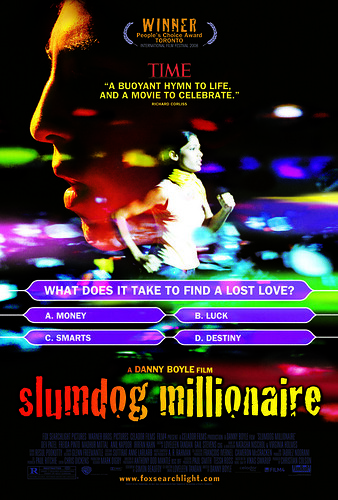
As Slumdog trudges towards its now all-but-inevitable Oscar win, I get more and more annoyed at the movie. It's not that I didn't appreciate Danny Boyle's hyperkinetic, technicolor spasmatics - they are most impressive. My beef was whether or not this aesthetic is appropriate for such a horrific story. I was hardly the first to find Boyle's movie thematically similar to classic Dickens novels but Slumdog has one crucial difference: Dickens made squalor seem, well, disgusting. Boyle makes it pretty. I came across this David Denby quote today in the New Yorker and I think he hit the nail on the head:
As slum children, Jamal and his friends are enchantingly beautiful, but the supersaturated color makes not just the kids but every surface and texture shine glamorously, including the piles of garbage that Jamal and his brother live among. Boyle has created what looks like a jumpy, hyper-edited commercial for poverty—he uses the squalor and violence touristically, as an aspect of the fabulous.

You should walk out of Slumdog feeling horrified at the depravity and poverty in India's slums. But that would give the movie an actual social conscious and political slant; there is no room for any of that in a fairy tale. Instead, Boyle wants you to dance down the aisles as you exit - Bollywood style! To the celluloid Gods I plead: Please let MILK pull an upset!

Wednesday, August 27, 2008

Gay Marriage makes a widow...


Sad news. It seems that Del Martin, one half of the first same-sex couple to wed in California, has died at the age of 87. If there is any couple that should riddle the proponents of prop-8 with doubt and shame it was these two. Here is the link:

Friday, August 8, 2008

Virtual Thespis!

For all of CGI's wonders the technology has yet to capture that most ineffable and important of images, the realistic human face. Looks like that's all about to change! CGI characters with complicated emotional expression, like Gollum in The Lord Of The Rings, are getting better and more realistic every day, but actual human faces have still been, in my opinion, a distant dream. But this new test clip gives me pause. With technology progressing like this, in 50 years will the actor be a thing of the past? A relic of antiquated cinema technology thrown into the dust-bin alongside stop-motion animation or CinemaScope? I doubt it but...if a perfect computer simulation of a human face (that is is to say an indistinguishable one) is a 10, this is at least an 8.5!

I Am A Scam-DOWNLOAD ME!


Now why can't I think of these things?

From Gizmodo:
Confirmed: Eight Morons Bought the $999 I Am Rich iPhone Application

The New Pseudo-Intellectual!


David Brooks, he of "Bobo" phrase-coining fame, has a great new article on the subtler points within the world of contemporary pseudeo-intellectualism. Navigating the minefield of 21st century snobbery is a treacherous endeavor, lined as it is with 20th century pitfalls. Quoting Slovoj Zizek is a must, but referencing Baudrillard or Norman Mailer, well, you may just as well start collecting a social security check early. Reading the New Yorker every week is, however, still a prerequisite. Like Death and Taxes, some things never change. Thank God we have the always funny and satiric Brooks to set us straight.
Money Quote:

Now the global thought-leader is defined less by what culture he enjoys than by the smartphone, social bookmarking site, social network and e-mail provider he uses to store and transmit it. (In this era, MySpace is the new leisure suit and an AOL e-mail address is a scarlet letter of techno-shame.)

Today, Kindle can change the world, but nobody expects much from a mere novel. The brain overshadows the mind. Design overshadows art.

Thursday, August 7, 2008

Where is Henry Higgins When You Need Him?

This is kinda stupid and goes on too long BUT...it made me laugh. Batman definitely needs some elocution lessons!

Friday, August 1, 2008

Bobo say "Hipsters Are Not Hip!"


Being a Bobo, my interaction with Hipsters has been mostly tangential. An endlessly dissectible social phenomenon, my feelings toward the group have always been apathetic at best. Seeing how apathy is the dominant stance of a hipster toward, well, everything, the reaction is not without some appropriateness. I do love reading about them though. Here's the link for a biting smackdown of the whole hipster counter-culture. Here are some money quotes:
The American Apparel V-neck shirt, Pabst Blue Ribbon beer and Parliament cigarettes are symbols and icons of working or revolutionary classes that have been appropriated by hipsterdom and drained of meaning. Ten years ago, a man wearing a plain V-neck tee and drinking a Pabst would never be accused of being a trend-follower. But in 2008, such things have become shameless clichés of a class of individuals that seek to escape their own wealth and privilege by immersing themselves in the aesthetic of the working class.


An amalgamation of its own history, the youth of the West are left with consuming cool rather that creating it. The cultural zeitgeists of the past have always been sparked by furious indignation and are reactionary movements. But the hipster’s self-involved and isolated maintenance does nothing to feed cultural evolution. Western civilization’s well has run dry. The only way to avoid hitting the colossus of societal failure that looms over the horizon is for the kids to abandon this vain existence and start over.


An interesting response is here. His money quote:

The question, though: does any of the above matter? Adbusters seems to think that because a portion of youth culture subscribes to this meaningless lifestyle that Western civilization as we know it is doomed. Their mistake is to assume that those who choose hipsterdom had the potential to be meaningful cultural contributors in the first place. If you'll allow the analogy, hipsters are the thieves that would never be customers. If they valued anything in the first place, they wouldn't have made the unconscious choice to value nothing.


While a tad alarmist, I am incined to agree with most of the AdBusters criticisms. If the earnestness and "free-love" flower-power dreams of the 60's seem silly to jaded modern eyes at least we can say that the Hippies really believed in their dreams of social progress, free-love and a liberated consciousness. Hipsters, believing only in irony, exist in an ocean of random yet meticulously chosen signifiers, undoing all meaning rather than bolstering it. Neither left nor right, political ideologies are something to be undermined and not endorsed- a lazy cynicism about progress is a staple of the hipster diet. Indeed, they could be called anti-Hegelian but even being against an ideology is to retroactively endorse the concept of ideology itself. But, maybe this is the Hegelian end of history: Francis Fukuyama's dream of capitalist democracy's triumph is true, but the price we pay is that we all morph into self-referential, uber-sarcastic, consumption pod people who, in capitalism's sneakiest trick, think that this very consumption is the purest expression of our individualism. Self-obsession and the free-market go hand-in-hand, and by being too "meta" to believe in meta-narratives anyway, the hipster is nothing if not self-obsessed- all the while, like a moth to a flame, subscribing subconciously to the most insidious kind of groupthink and conforming to the most rigid and insidious social standards. I suspect the only way to eradicate this hipster problem is satiric ridicule. And so, for your enjoyment pleasure...who needs Beijing when you have THE HIPSTER OLYMPICS:

Blurring the line between hilarious and inappropriate....

At least he makes sure that we know he just was too tied to write a guy version of the song. Lest anyone get any ideas....

Friday, July 25, 2008

NEW ARTICLE!

As you may know, this blog has been light on material for the past few months because I've been busy writing for a great web magazine called The Simon. I have been thrilled to be in such a great company of writers. Check out my newest article, this time on video games (quoi? you ask. Just check it out). Check out these youtube clips first:


My Friends Are So Funny!

Quick plug for my friends Jeffrey and Cole also known by their YouTube moniker: VGL Gay Boys. I can't figure out which one is Rowan and which is Martin. Or is it which one is Martin and which one is Lewis? Or maybe which one is Lewis and which one is Clark? In any event, they are hilarious. They are writing a new column for HX magazine-the New York gay rag- and have some live dates coming up. The info is posted below, as is one of their hilarious videos. For an added chuckle I'm also posting the Golden Girls Parody we made together. Check them out:

TWO NIGHTS ONLY at the D-Lounge,
at the Daryl Roth Theater in Union Square!

JULY 31st at 10PM
AUGUST 7th at 10PM

Directed by Christian Coulson
Musical Direction by Michael Arden, the bartender

Featuring a SURPRISE CELEBRITY GUEST!

Tickets are $5 at the door
(no drink minimum but a full bar!)

For info and reservations email VGLGAYBOYS@gmail.com


Wednesday, July 23, 2008

I'm a New Old Gay!


I'm a "New Old Gay!"-and proud of it. Check out this great article from the New York Observer....every word of it is true. Marie's Crisis WAS the first piano I ever visited. Money Quote:
To be classified as a New Old Gay requires more than an appreciation of Patti LuPone, though love of somewhat tragic, just a tad grotesque, totally fabulous divas is a requirement. In some ways the New Old Gay can be read as a reassertion of a gay identity that had all but been given up for dead: If gays can be married and have children and live contentedly in the suburbs, or on the other end of the spectrum, do the same drugs at the same loft parties as their Oberlin classmates, and if everyone thinks AIDS is no more serious than diabetes, then, really, what’s the difference between the gays and the straights? By dialing back to and reinventing the old gay stereotypes, they may have the best shot at reclaiming gayness as something actually different.

Tuesday, July 22, 2008

Long Day's Journey into THE DARK KNIGHT. A Dissenting review.


When people ask me if the much lauded new Batman movie The Dark Knight is as good as the critics are saying I first ask if they liked Batman Begins. If they respond that they do, I assure them that they'll probably like the new Batman even more. If however they were, like me, disappointed in Christopher Nolan's first go-round with the caped crusader, then they will probably be equally unimpressed by the sequel which, in many ways, offers more of the same. While The Dark Knight is in most ways a more exciting, involving and thrilling film than it's predecessor, it also pissed me off more than Batman Begins and highlights the deficiencies in Nolan's interpretation of the character more acutely.

Memento was one of the greatest films of it's genre; more than a simple screenwriting stunt, Memento transcends it's M.C. Escher narrative gimmicks and uses it's plot to question deep and philosophical problems about human nature, epistemology, and the power of memory. Nolan's The Prestige, though less successful, was a film about illusions that itself was something of a mind-bending magic trick-though the thematic ideas raised never quite became actualized with the elegance that Nolan displayed in Memento. In any event he is certainly one of our most important and talented new filmmakers. But his take on Batman is all wrong.

Batman Begins was primarily a reaction to the so-campy-drag-queens-stayed-away aesthetic that Joel Schumacher employed in his two terrible Batman films, Batman And Robin being one of the worst big-budget movies ever made. Draining away all humor, color, and camp Christopher Nolan refastened Batman as an utterly realistic action film with "deep" Freudian overtones. Nolan was willing to "take Batman seriously" and fanboys swooned.

Bumping up the portentousness and length, The Dark Knight only furthers Nolan's tunnel-visioned agenda. If Batman Begins was a globe-trotting action movie with a kung-fu vibe, The Dark Knight is pure contemporary crime caper, more reminiscent of the Michael Mann oeuvre or Scorsese's The Departed than the other Batman films. And here is the problem: to play Batman with a totally straight face-to demand that the audience believe in the "realism" of the story is to siphon away all the mythic and larger than life undertones that sustain Batman in our collective imagination. Worse yet is that Nolan is not even playing by his own rules, fashioning a story that, upon even the barest scrutiny, is utterly ridiculous, confusing and plain unbelievable. Of course, stretching the credulity of an audience in a superhero movie is par for the course, what makes it a problem here is Nolan's bull-headed refusal to own up to this fact. Everything stylistically about the movie asks us to take what we see literally. But to do so is to believe in a confusing plot with gaping holes and all-too-convenient turns of events.

I guess I should be up front and say that I think the original Tim Burton Batman is the pinnacle of the genre: a stylish, funny, brilliantly-cast, popcorn picture that strikes a perfect balance between the silly and the serious. Burton's sequel pushes both those two categories even further making for a Batman movie that, while fascinating, was more about Burton than Bob Kane's creation. Burton, with Anton Furst and Bo Welch's invaluable assistance, created a whole world for Batman, one that was not exactly contemporary but not period either-it was as much set in '39 and '89. A dark, squalid Gotham City of Gothic Arches and expressionistic angles, it was a world where a Batman makes sense. Our hero was an extension of the unique urban mise en scene. Nolan's Gotham is a bland, non-descript realistic city (actually Chicago) where Batman looks like a non sequitur. In this environment it's hard not to feel that a man dressed as a bat is not just bizarre but downright stupid. As is a homicidal terrorist dressed as a clown.

Speaking of the clown, there is one bright spot in this movie and it's the one everyone is talking about- Heath Ledger's performance as The Joker. Relentlessly fascinating, Ledger dives headfirst into Nolan's rethinking of the character. No longer a demented comic prankster, The Joker has become a no-holds-barred terrorist with a nihilist streak. The screen comes alive whenever he is on. Stumbling out of a burning car licking his lips and grinding his yellow teeth, the image is hard to take your eyes away from. Ledger is a monster for the ages. Though his sense of humor is a only fit for an audience of one (he does have one sick and funny bit with a pencil) his lithe gait, and emotional unpredictability make him immensely watchable. Sadly, while Ledger performs admirably, Nolan's overall vision of the character suffers from the same problems that plague the whole movie. More a textual effect than a character, like Chiurgh in No Country For Old Men, The Joker is an idea actualized. Spouting lines that sound like fringe characters in Tom Stoppard's Coast of Utopia trilogy, this Joker informs us of his ideological perspective at every opportunity. He's sounds like Max Stirner on a mean bender. As he tells one character, "I am an agent of chaos." Yeah, no shit. What's ludicrous is that there is no point, as there arguably is in "No Country," where the filmmaker pushes the character into that ambiguous realm where the audience questions his very authenticity as a "real person." Yet, looked at objectively, Ledger's Joker does utterly impossible things: single handedly take over the crime syndicate of Gotham, avoid any and all detection by the police (even though he's hardly, shall we say, inconspicuous), lay trap within trap and plot within plot-a matryoshka doll of scheming impossible to actually execute, (Oh, I see he planned to get caught only to escape by detonating the bomb he planted in the other inmates stomach beforehand. How very, ahem, elaborate!) and most egregious of all, he plants massive, massive amounts of explosives at relatively protected buildings and boats and no one notices! Even his total absence of back story is a testimony to a conception of the role that is more than human. One can but wish Nolan had the guts to create a whole world where this sort of character made sense. Instead, the gaps in the plot look like just that: gaps.


The rest of the cast fares moderately with Bale having almost nothing to do as Batman but growl as ridiculously as he did in Batman Begins . He has even less to do as Bruce Wayne. Just as Tony Stark is more interesting than Iron Man and Clark Kent's the thing that makes Superman enjoyable, Bruce Wayne should have a character to play that actually holds our attention before he dons the batsuit! So far only Michael Keaton has played a Bruce Wayne who is anything but bland. Aaron Eckhart is fine as Harvey Dent/Two-Face though the maneuvers in the plot that turn him into the villain feel forced, as does the bizarre, over-determined canonization of Dent at the end of the film. Maggie Gyllenhaal is an improvement over Katie Holmes (as every single review is OVERJOYED to mention-is there some weird Schadenfreude going on here?) but the character is still a non-starter. Vicki Vale had more to do. Not to mention that the chemistry between her and Bale is utterly phlegmatic. Michael Caine and Morgan Freeman add some gravitas to the proceedings but their characters are still only plot placeholders and mouthpieces for Nolan's thematic occupations. Neither are granted a life outside the narrowly confined cog they serve in the plot. Perhaps the best supporting performance is by Gary Oldman (what role can't this man play?) who imbues Commissioner Gordon with real sensitivity and dignity. He is the real heart of Gotham. Nestor Carbonell makes for a Gavin Newsome-esque mayor and it's a delight to see the underemployed Eric Roberts as a big shot wise guy.

Ultimately, The Dark Knight collapses under the weight of its own ambition and self-importance. If the moment to moment excitement of the action was stupendous the lugubrious hand wringing would be more forgivable but Nolan, as in Batman Begins, has little clue how to film an action sequence. While there is one exciting car chase sequence in the films middle and the bank heist sequences that opens the movie has some style (though of a kind not a appropriate for a Batman flick) most of the action is an over edited, extreme close up-ed mess. While Burton was never a Spielberg or Cameron when it came to action sequences, he nonetheless was able to give them a narrative clarity and perspective that was both fun and lucid. The finale of The Dark Knight by contrast is an incomprehensible, darkly light, tortuously organized set piece that, using his new batty echolocation powers, Batman saves various hostages, fights the cops (though hurting none of them), disposes of some fake Batmen and finally has a showdown with the Joker who, wouldn’t ya know it, is protected by a hitherto unseen pack of hungry Rottweilers. Half the sequence is shot in sonar and the other have in near total darkness. Needless to say it's anticlimactic-especially true since we have a further climax and showdown with Two-Face yet to come.

Confusing humorlessness, literalness and solemnity with profundity and seriousness of purpose, Nolan can't make Batman soar. In the end, for all its talk about justice, chaos, social rules and vigilante violence, the films themes are extremely muddy. The finale even implies that a noble lie is better than hard-earned or tough-to-swallow truth (and it doesn't even illustrate convincingly THAT point of view). Is that what Batman has come too, a dirge? A sepulchral morality play that can't even muster up a coherent lesson to teach? Is having, you know, "fun" at a Batman forever off-limits. Though Ledger sometimes breaks through the barricades stacked against him, with Nolan at the helm, those days are over.

In a final note, I want to say something that the rabid fans are going to get their panties in a twist about. It's easy to wonder: Why all the love? Why the knee-jerk approval and devotion to Nolan's conception of Batman? I don't want to disparage any viewer’s enjoyment of the movie for its merits. I am sure many people like and even love the film for the qualities in it, even if my take on those very same things garners the opposite reaction. I venture to guess however that the critical hosannas showered upon Batman Begins and The Dark Knight is largely due to a deep desire in comic book fans (or at least comic book movie fans, which is to say a majority of the American population) to have their hobby taken seriously as art and a equally deep desire in critics to have summer blockbusters at least attempt somthing resembling thought and art. Though anyone who pre-judges any work of art based on the stereotypes of its genre is a douche bag, it is nonetheless true that superhero movies are usually considered adolescent larks, comic books themselves neither legitimate as art or literature. While this attitude is unfair, the prejudice is widespread and not without some justification. By making a realistic, humorless Batman series and weighing it down with heavy-handed talk about "fear" "justice" and "chaos" the fanboys feel legitimized and the critics are simply grateful for the gesture. "See, all this comic book stuff isn't just for kids! Look how MEANINGFUL and SERIOUS it all is!" If fanboys have too much fun at a Batman movie it only reinforces the idea that Batman is something fit for a Happy Meal and if critics have to much fun the assume it can't be a good film behind all the frivolity. Approval by the chattering classes and the mainstream is something important to people, even though many deny any such thing. A movie like The Dark Knight begs to be treated as a "serious" work of art. What's ironic is that this desire is the exact thing that makes it fail.

Tuesday, January 15, 2008

No Day But Today....

If my generation has a musical, and (I'm afraid to say) it probably doesn't, it's RENT. So though it's had a remarkable long run at the Nederlander Theatre on Broadway I couldn't help but be saddened by the news that it's time has finally come. My favorite memory of the show: Algebra class Freshman year of high school. Sitting in front of me was BJ, a large somewhat effeminate black boy. Day after day instead of paying attention to mathematrical proofs and the quadratic equation BJ would teach me the lyrics to Rent's showstopping Act-One closer: La Vie Boheme. It would be two years before I saw the show on Broadway but, by the time I did, I already knew the whole thing by heart. Goodbye Rent, we'll miss you!

Tuesday, January 8, 2008

Go Hillary!


Now that Edwards is all but dead in the water, Bobofag has become a full-on Clintonhead! I don't know what it is about Obama: His "above the fray" attitude? His bad health care plan? His habit of style over substance (what does all his talk of "change" even mean?) Whatever it is...I'll take Hillary's tough talk and specific policy initiatives any day. Plus, it's about time we get some estrogen power into the White House. Congrats Hill on New Hampshire...no one thought you could do it and you proved them wrong!

Wednesday, December 26, 2007

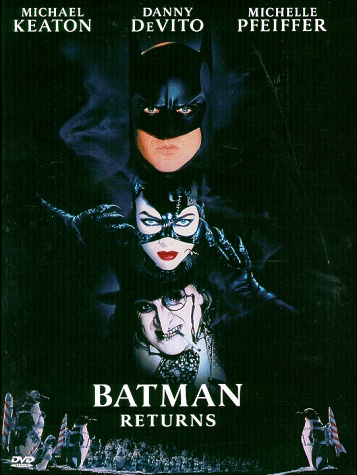
Tim Burton: Batman Returns (1992)


Batman was indisputably one of the biggest box office smashes of the 1980's and director Tim Burton was given the lion's share of the credit (and rightly so.) When the inevitable sequel was produced the director was awarded a level of control and trust that is rare within the mainstream studio system. Burton could pretty much do whatever he wanted. The result: a truly bizarre and unique Burton blockbuster (emphasis on the Burton) that pushed the boundaries of the genre even as it failed within them. Batman Returns was a box office hit to be sure, but on a much smaller scale than the original. Perhaps audiences were turned off by the films glum tone or it's overly fussy and complicated plot. Unrelentingly psychological, Batman Returns is totally flaccid as an action movie; the director seemingly having little patience for the elaborate and repetitive choreography that such sequences require. Instead the film functions as a study in the mental instability of it's main character; a better title would have been Batman: Deconstructed.

Dualities are everywhere. Metaphors of masks abound. Gotham city itself is turned into a theater of Freudian psychodrama. When I first saw the movie I was put-off by the abundance of villains in the piece- there are no less than three. I felt my focus being pulled in too many directions. What I now realize is that these three figures represent different aspects of Batman's psyche; his fight with them is actually his internal struggle with his own demons. Indeed we can see these characters as the classic Freudian modalities of Id, Ego and Superego.


For the Id we have the Penguin, Oswald Cobblepot (played by a snarling, barking Danny DeVito, channeling Burgess Meredith by way of Cujo). A brutal monster, lacking impulse control as much as he does dental hygiene, the Penguin is Batman's primary foe in Batman Returns, but even more importantly he is Wayne's inner darkness distilled and given a fetid, abhorrent form. The importance of animal imagery is pronounced: the Penguin is not human-he knows he is a monster..."I am an animal. Cold-Blooded!" As the penguin says to Batman "You're just jealous because I'm a real freak and you have to wear a mask." Biographically however, the Penguin is Bruce Wayne's dark doppelganger. Born into privileged homes, both were "abandoned" by their parents at a young age-an event that defines each mans identity. At a press conference where he visits the grave of his parents, the villain declares them forgiven as Bruce Wayne looks on. But, their absolution is a publicity stunt. Bruce Wayne too has not forgiven his parents for leaving him; he represses his anger toward them by punishing the criminals who took them from him allowing his parents to stay innocent (which of course they were, but this about irrational emotion here), a fetish of their memory is what remains. But Wayne's Id, it's desire to confront the feelings of resentment, get an outlet with the Penguin. There is a caveat. Cobblepot can only exist fully as a vile, uncontrollable monster, literally dwelling beneath Gotham, just as Wayne's monstrous animal id hides in the recesses of his mind, or least in his Batcave. When the feelings rise up to the surface and show themselves, pandemonium ensues.

Wayne's Ego is the corrupt billionaire industrialist Max Shreck, played to smarmy perfection by Christopher Walken in a fright wig. This is the public face of Wayne: rich, charming and successful. The interesting thing about the addition of this character is that, along with completing the Freudian trifecta, for the only time in the Batman movies is Wayne's guilt regarding his wealth even alluded to, however elliptically. Though he wears no mask, Shreck is as duplicitous a character as Wayne-legitimate business man by day and corrupt robber baron by night. Though with Shreck the duality is almost totally submerged- his villainy a natural extension of his profession. As Michael Atkinson points out in his Village Voice review of "Batman Begins," the Batman movies have always ignored any possible connection between the squalor and crime in Gotham city and Wayne's profession as a ludicrously wealthy business man. Though this level of social commentary is not realized in Batman Returns (or any Tim Burton movie), it is at least alluded to with Shreck. (Also alluded to is the cinema of German expressionism where the lead in Nosferatu was played by none other than one Max Shreck. And the Penguin is pure Caligari. But this is all neither here nor there.)


Finally we have a truly fascinating character played by Michelle Pfeiffer (in her best screen performance): Catwoman. Burton's only true successful female character (until Mrs. Lovett in Sweeney Todd) and his only foray into matters sexual, Catwoman is pure Super-ego. As Lacanian film theorist and philosopher Slovaj Zizek has often noted, the super-ego is not a moral agency. It is consuming voice that constantly and relentlessly bellows irrational demands on it's agent. Perhaps most interesting is Zizek's assertion that the Super-ego is connected deeply with the Id, the two aspects of the psyche being delicately reflective of each other. Norman Bates taking the corpse of his mother from the Super-ego attic to the Id basment is Zizek's example of a potent cinematic representation of this connection. In Batman Returns we can find another. Like the Penguin, but unlike Shreck, the Catwoman, like the Penguin (and like Batman for that matter) is an animal image.

Extremely articulate, undeniably witty and unabashedly sexual, the Catwoman is the Super-ego run amok, having totally discarded all pretense of social normality. Her first big battle with Batman occurs, appropriately, on a rooftop, just as the Super-ego sits at the highest level of subjectivity. Catwoman is also the nexus of Wayne's central neurotic predicament for she, unlike the Penguin or Shreck, is constantly fighting with her dual nature, the madness of her psychology displayed in the films most memorable scene where Selina destroys her pink-hued apartment and transforms into Catwoman. When she kills Shreck in the films dark final scene she finalizes the death of her and Wayne's Ego, preferring instead to remain the animal that she has become. And though the Penguin dies in this same moment, he is thematically returned to the subconscious, hidden in the sewers of Wayne's mind. Batman's attempts at reconciling his psychic traumas have been unsuccessful and even destructive. There seems little hope that Wayne will ever move beyond his schizophrenic predicament. Though he has once again saved Gotham, this, the real central conflict of the film, is not a setup for, as the Catwoman says, "A Happy Ending."

With Catwoman Burton also dabbles in sexual politics. Selina Kyle is a highly gendered character when we first meet her. Passive, pathetic, soft-spoken and sexually inert. "Hi Honey I'm home..oh that's right I'm not married" is her lament upon every return to her feminine apartment. Her lack of a "man" troubles her and at the same time defines her. Catwoman is a Betty Friedan nightmare, a dangerous castrating creature of menace powered by rocket fuel estrogen. With her S&M get-up of shiny pleather and her sybaritic line deliveries that practically echo Mae West-this Catwoman is more vagina than pussy.


As one can imagine, Bruce Wayne gets lost in the shuffle. The whole movie being a
representation of his psyche, Wayne is even more of a cipher here than he was in the first film. The few moments of character development allowed the talented Mr. Keaton are in relation to his budding romance with Selina Kyle, a duality again mirrored by Batman's more overtly sexual and violent meetings with Catwoman. The slight humor Wayne displayed in the first Batman is blunted even as the movies tone verges farther toward the whimsical.

Though Batman Returns is a far less comic film than it's often witty predecessor, it's mise en scene has a far more macabre frivolity. Returns is, in every way, more Burton's films than Batman was and his signature touches threaten to overtake the whole movie, for better or for worse. After Anton Furst committed suicide during pre-production Burton turned to his Scissorhands collaborator Bo Welch for production design. If Furst made Gotham into a mysterious expressionistic cesspool, Welch turns the city into a Transylvanian carnival. Color is everywhere, pronounced all the more by the surrounding darkness. Equally abundant is white snow. Setting the story at Christmastime has to be a sick joke of some sort; it adds nothing to the plot.
Burton's always been more Gorey than gory and in Returns his penchant for curlicue trimmings kills the sense of dark menace and urban blight that epitomized Furst's Gotham. It's no wonder that Batman battles a gang of demented circus clowns; who else to populate Burton's circus of Hell? With all the clowns running around in the white blankets of snow the mood can get deciedly Cirque Du Soleil. Also ratcheting up the sideshow aura is Danny Elfman's score which, although featuring some of his best work (Selina's transformation again is a highlight), is nevertheless oppressively heavy on the creepy-yet-innocent choir of "ooh's and laah's" that Elfman finds so fetching. In almost...every...movie. Burton, always afraid to have a moment on screen without oppressive musical accompaniment does nothing to reign him in. The original Batman hinted that Elfman could become the new John Williams, with Returns he negates any such ambition; he is simply so wrapped up in his own sound that that is all he, and the audience of a Tim Burton movie, can hear.

Obviously, Batman Returns is an interesting movie--much more so than almost anyone gives it credit for, including myself until I started thinking about it. Playing as it does on complicated psychological and sexual issues, a box office fallout was inevitable. It's important to remeber that though that, out of the shoadow of the previous iteration, Batman Returns was still amazingly successful. Perhaps the name brand recognition was still hot enough to secure an impressive release, or perhaps the films themes were subtextual enough to not sink the whole thing under the weight of it's own metaphoric import (see: The Hulk, dir. Ang Lee). Whatever the reason, the movie made a lot of money but it's comparative failure to the earlier Batman I can't help but to believe came about by it's somewhat serious engagement with the issues that I have noted in this review. The result was one of the more disappointing entries in the now tirelessly burgeoning genre of Superhero film, but one of the greatest (though flawed) entries in Burton's oeuvre. It's without question a film worth watching again.

Monday, December 17, 2007

Sondheim: Follies (1971)

It could never happen again. It should have never happened at the time. The unbelievably extravagant, exceedingly expensive and ridiculously ambitious 1971 musical Follies was a musical perhaps doomed to failure.  Shockingly downbeat, Follies marked the end of a Broadway that sparkled with glamour and fantasy, ushering in a new area of cynicism and modernity. It was another experiement in creating a whole new kind of musical. Follies began in the mind of Stephen Sondheim as a murder mystery called "The Girls Upstairs." After much reworking, and with Hal Prince's guiding hand, the show transformed into a massive eulogy for youth, hope and old "42nd Street" showbiz.  Inspired by a startling photograph of Gloria Swanson amid the wreckage of an abandoned, dilapidated theatre, Follies is set at the first, and last, reunion party for Weissman's Follies (a transparent Ziegfield stand-in) before the old theatre gets torn down. As one character barbs, "Just what this city needs, another parking lot."  Specifically focusing on two middle-aged former Follies girls and their stage-door Johnny husbands, (Sally and Buddy, Phyllis and Ben, respectively) we are invited to luxuriate in the destructive dynamics and long stewing resentments of two collapsing marriages. Old romances are rekindled (and discarded); hopes for the future are shown futile.  Through the metaphors of show-biz, these domestic dramas are elevated into the more universal crisis of age and loss.  A true concept musical, the action plays on a dream stage where the ghosts of the past literally share space with the harsh realities of the present.  

There are two kinds of music in Follies. Most transparent are the pastiche; songs written deliberately in the manner of the tin pan alley tunesmiths of the 20's and 30's.  The other songs are uniquely Sondheim-esque and contemporary.   All are brilliant. In Follies Sondheim was able to display his complete mastery of theatre music, tossing off Irving Berlin and George Gershwin homages that often outdid their real inspirations.  Better yet, Sondheim's lyrics in these pastiche numbers worked on two levels: they are fully believable as period pieces and they also subtly comment on the action, providing discomfiting irony to each musical moment.  No where is this more obvious than in the Act-one showstopper "Who's that Woman."  As the aging chorus girls sing a cheery bouncy dance number, the lyrics cut to the quick. "Who's that woman?/That cheery, weary woman/Who's dressing for yet one more spree?/Each day I see her pass/In my looking-glass--/Lord, Lord, Lord, that woman is me! "  As they dance with their old selves, the ladies "mirror" image becomes all the more poignant-their feeble attempt at dancing more pathetic.   Even the grand opening, a parody of Irving Berlin's Follies classic "A Pretty Girl" called "Beautiful Girls" has a more than subtle hint of the pathetic and grotesque to it,-as all the old, wrinkled, heavy and frail former Follies girls parade down the staircase one last time, nostalgia quickly transforms to sadness and disgust.

Eventually the regrets and recriminations of the the four main characters comes to a head, boiling over and transforming the stage into a new and one-of-a-kind show; a full-fledged Follies of psychological dysfunction and released repression.   As each of the main characters has their moment in the spotlight the futility of the entire endeavor becomes more and more obvious. Eventually invoking a nervous collapse from Ben, the stage becomes awash in a cacophony of noise-all the characters bellowing while the orchestra thrashes in a nonsenical din.  Leaving the party with the spouses they came with, the characters may leave wiser for the wear-but happiness remains nonetheless an elusive dream.

A massive cast, an incredible orchestra, costumes opulent beyond any seen since--Follies was one of the most expensive shows Broadway had ever seen.  All this to service a show that, as described above, leaves it's audience less than joyful.  The critics that disliked the show focused on Williams Goldman's book which they saw as petty.  Why would anyone want to spend an evening with these four sad pathetic people who spend a whole show complaining and bitching with each other about events long since passed? The point is not without insight but what those critics missed is the more universal and powerful thematic ideas facilitated by this plot. No, the characters don't really change or grow, but that is, of course, the point.  Sondheim and Price simply weren't interested in playing by the rules. The shows most insightful review was written by a Harvard student, a precocious young fellow named Frank Rich.  He had already written his place in the history of criticism with a line that epitomized Follies raison d'etre: "There is no getting around the fact, that a large part of the chilling fascination of `Follies' is that its creators are in essence presenting their own funeral."

Follies did not recoup it's invest despite a run of 522 performances on Broadway.  A National tour also fizzled early.  Ever since, the show has achieved a legendary status, not only for the brilliance of it's score but for the perfection and unattainable opulence of the original production.  Chronicled in the book "Everything Was Possible" by Ted Chapin, the history of Follies is mythic among theatre aficionados and for good reason.  But this has not stopped people from attempting to remount the show and make it a viable entertainment once again.  A star-studded 1985 concert with Mandy Patinkin, Barbara Cook, George Hearn and Lee Remick cemented Follies status as one of the most brilliant scores in Broadway history.  The 1998 Paper Mill Playhouse Production dared to ask if a fully mounted revival could succeed. The answer seemed to be a resounding "yes!"  Critic swooned. When an slimmed down revival appeared on Broadway in 2001, the results were underwhelming.  Once again Follies proved a classic problem play, unrelentingly interesting but stubbornly unproducable.  The recent critical and commercial success of another concert staging, this time at City Center Encores, stirred up discussions of yet another possible try for Broadway gold-but so far no official word has confirmed the chatter.  

And probably for the best.  Follies will never be a commercial success; it's subject matter too bleak, it's financial demands too great.  In a concert staging, pressures are lessened and the imagination takes hold, closing the gaps that a real production would have to fill.   For those who saw it, memories of the original persist.  For those who didn't, like Bobofag, the idea of a fully realized Follies is probably better than the real thing.  Follies remains a frustrating, sad, dark and numbingly brilliant musical, all the more enticing for it's many flaws.  It's unrealistic demands of production and it's taxing emotional experience for the audience make Follies better imagined than real.  Like a young child staring at his beautifully wrapped Christmas gift, the toy itself can never quite live up to the anticipation.  

LIZA MAY!

The infamous concert where she collapsed. Get better Liza, we love you!!

Wednesday, December 12, 2007

Bad Marketing Ideas

Believe it or not, only one of these is a fake. Can you guess which? I'll give you a hint, it's not the one that bought advertising time during Project Runway (raise of eyebrow).


Monday, December 10, 2007

Kant '08

Bobofag proudly admits that he was once a nerdy philosophy minor in college. His thinking still occasionally drifts toward the metaphysic and epistemic. So he did laugh most heartily when he saw this attack ad on youtube. Good Kantian that he is, Bobfag does not endorse it's contents:


Sunday, December 9, 2007

Bobofag loves Frank Gehry.


I made my first pilgrimage to the Walt Disney Concert Hall last night, and it provided me as close to religious sensations as a secular gayboy can hope for. I was in no secret way obsessed with Gehry's Bilbao Guggenheim museum ever since I first saw pictures of it in the 90's. Whether one viewed it as the climax and pinnacle of the 20th Century's Architectural Narrative or the Beginning of the 21st's (for surely it was one of those two) The Guggenheim was, by any measure, breathtaking. Though I have not had the good fortune to see Bilbao's great new tourist attraction, I had been chomping at the bit to go inside Gehry's Concert Hall in downtown LA, a building that was planned before the Guggenheim and resembles the structure in style and material. At least on the outside. Before last night I knew I loved the Concert Hall's exterior: an elegant and disorienting scrap of tangled silver metal which looks entirely different from any particular vantage point. More enlightening however than playing peek-a-boo Rashomon with the outside is stepping into the Hall itself. My fears that the Concert Hall was just "Guggenheim-lite" were totally unfounded.

The Walt Disney Concert Hall may be the best place in the world to listen to orchestral music, period. (I say "orchestral" because referring to the entirety of symphonic music as "classical" does a disservice to both the music and the listener. The Classical period is a specific time in music history sandwiched between the Baroque and the Romantic. Smothering centuries of musical history with the fusty title of "Classical" can only serve to further keep the fine arts in the realm of the pretentious bourgeoisies, divorced from the life of the proles below. No doubt some would have it that way, but only because their enjoyment of "classical music" is predicated by the sense of superiority they receive by listening to it. I'll have none of it. I will not partake in pushing, though nomenclature alone, average people away from enjoying amazing works of art. The ticket prices do a good enough job of keeping the riff-raff out, no? But I digress...) If Bilbao is anyone near as effective a place to see works of art as The Disney Concert Hall is a place to hear great works of music it would have to be a gallery in competition with the Louvre and MOMA.

The first thing that strikes you about the room is it's warmth; light, smooth wood is everywhere and the fabric pattern on the seats is floral and decorative-tres Californian too. The orchestra is seated in what feels like the rooms center, with audience all around. In actuality it's probably about a fourth closer to the "back" wall with more audience facing the conductors back than his face-as it should be. The ceiling is devoid of sharp angles, the whole space above you curves and undulates-it looks like it's morphing. The effect is perfect and conceptual too; after all, what is music but waves? Behind the orchestra is a massive organ with pipes that spit out in gold. This is surrounded by large jumbled wood planks which, I couldn't help but notice, resemble oversize French Fries. For me, the only other piece of architecture that has this same burst of beauty and composition is the stained glass window behind the altar of St. Peter's in Rome. Whether or not these decorative elements were chosen for acoustic purposes I know not. I do know that the sound of the orchestra in this room was unparalleled in my experience. While the expression that "one could hear a pin drop" is a cliche, Gehry's masterwork gives it meaning. (Sadly, along with the subtleties of Schumann, every cough from the preponderantly geriatric crowd is equally amplified.) The program I saw last night had four works by Wagner, Beethoven, Dvorak and Strauss, respectively. The first and last were my favorite, (Strauss' way with a waltz is unique in emotional depth) but all sounded impeccable.

Most concert halls have the power to make an everyman feel like an aristocrat but Gehry's work here makes the aristocrat feel like an everyman. Such is the egalitarian and unpretentious (though hardly unambitious) design of the Disney Concert Hall. It is a sort of Stoddard Temple brought to life and updated for the 21st century. A secular cathedral built to exalt not the God's but the genius of man; with it's own congregation (subscribers) and tithing system (box office) the analogy is apt. Such is the success of this building that I'll take Frank Gehry over Notre Dame any day.